I built an AI to watch a bird. She left.
I built an AI to watch a Common Redstart nesting in my garden. Two weeks later she left the box and never came back. The AI didn't notice — and that was the lesson.
A weekend project, an LLM, and what an empty nest box taught me about working with AI.
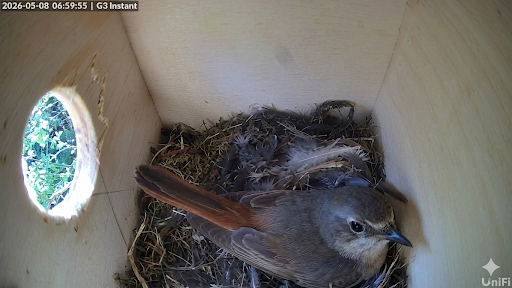
A Common Redstart nests in my garden every spring. The Swedes call her rödstjärt — red-tail. This year I built her a nest box and put a camera inside. And because I'd been looking for an excuse to use vision models on something real, I taught an AI to watch her.
It was a weekend project. One of those "I wonder if this works" experiments I make excuses to start.
Two weeks. Five eggs. One afternoon she flew out of the box and never came back. I don't know why. She might have moved on. More likely something happened to her — nature is cruel, and a small bird is one of the most disposable things in it.
This is what I built. What I learned. And what an empty frame taught me about working with AI.
What it does
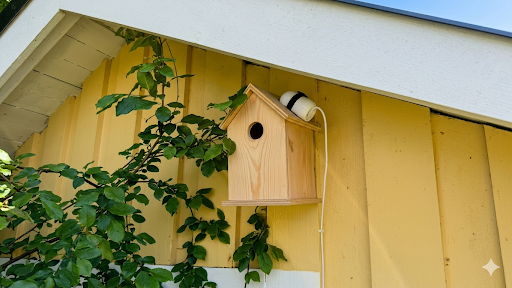
There's a camera in the nest box — a UniFi Protect, pulled over RTSP. Every five minutes the system grabs a frame and sends it to Google's Gemini. Gemini classifies what it sees: empty nest, adult arrives, eggs visible, incubating. A one-sentence narrative is attached to every event.
A motion trigger runs in parallel. The moment anything stirs inside the box, ffmpeg saves a few seconds of pre-buffered video. That clip also goes to Gemini, which describes what happened in it.
At the end of every day, a second model — Anthropic's Claude — reads everything Gemini saw that day. Frames, clips, captions, the whole stream. Claude writes a journal entry in the voice of a field biologist. Each entry includes a paragraph of biological context: why this species nests this way, what a clutch of five means, why she sits with her tail angled like that.
A local model on a GPU box in my office then reads the entry aloud, in a voice that sounds suspiciously like a famous nature narrator. It's XTTS-v2, running offline. The result is for an audience of one.
There's also a daily timelapse, a season-wide cumulative film updated nightly, and a species reference page with CC-licensed photography.
The two-model trick
The single most useful thing I learned from this project is not about prompts. It's about the architectural choice of which model does what.
Gemini watches every frame in real time. Cheap, fast, perfectly suited for that job. It looks at one square photograph at a time and decides what's in it. It has no memory of yesterday. It has no idea what a season looks like. It doesn't even know what frame came before this one.
Claude sits one layer up. Once a day, it reads everything Gemini wrote that day — and writes the journal. It also corrects Gemini. When Gemini misclassifies a single frame and a day's worth of context makes the mistake obvious, Claude catches it and overrides the label.
That split is the whole story. The cheap, fast model does the work that has to happen on every frame. The expensive, context-aware model does the work that needs the bigger picture. Neither would do this job alone. Gemini doesn't know what yesterday meant. Claude is too slow and too expensive to look at every frame for two weeks straight.
Once I'd built it this way, every other AI architecture question started to look different. Which model is best? is the wrong question. The right questions are: which model fits which job, and what does each one need to see to do that job well.
The principle isn't novel — match the tool to the job is as old as engineering — but the cost discipline underneath it is what I hadn't internalized. I would have read it in a paper and nodded. I had to build it before it meant anything.
The prompt that wouldn't behave
A bird sitting in a hole looks like a bird sitting in a hole. It's the same picture whether she's building the nest, laying an egg, or incubating. A human birder distinguishes between these by knowing the calendar, by remembering yesterday, by reading the posture in context.
Gemini can do none of that. It sees one frame, in isolation, with no memory. So the prompt had to do all the work that context would normally do — encode, in plain text, the rules a birder carries in their head.
I rewrote it a few times. Each version taught me something concrete about how this generation of vision models actually fails — which is not, importantly, the same as how the demos say they fail.
A few of the things I had to teach the model. That a clutch is built up over five or six days, one egg per day, before incubation begins — so a frame in mid-May with three eggs and a sitting bird is laying, not incubating. That nest-building is bursts of movement with material, and incubation is stillness for hours; the cue is duration, and you can't see duration in a single frame, only posture, and posture is ambiguous. That "absent from box" and "absent from frame" are different things, because the bird might be on the lip, just out of view, or genuinely gone.
The rewrite that mattered most wasn't any of those. It was the one that taught the model when to say unclear. Every previous version had tried to make Gemini smarter. The version that finally worked was trying to make it humbler. A model that confidently mislabels every fifth frame is worse than a model that abstains on the hard ones.
When she didn't come back
She incubated for a few days. Then one afternoon she flew out of the box and never returned. The camera kept rolling. Every frame since has looked the same: five small eggs on a nest, no bird.
Gemini classified all of those frames correctly. No bird present. Hundreds of frames in a row, all labeled accurately. And it missed entirely the most important thing that has ever happened in front of that camera.
Not because the prompt was bad. By that point the prompt was the cleanest piece of writing in the project. It missed it because the model could only see what was in the frame. The absence wasn't in any frame. The absence was in the relationship between today and yesterday — and a model that judges every frame in isolation cannot see relationships.
Claude could have. Claude reads a whole day at a time. But the system I'd built wasn't designed to ask is anything missing that should be here? It was designed to describe what was present. And the journal entries since have done exactly that — accurately, clinically, the way a real field biologist's notes might read. No activity. Nest abandoned. Cause unknown.
The model is doing its job. The model is doing it correctly. The model has no idea anything is wrong.
What I'd actually take from this
I've been thinking about why I built this. It wasn't useful. Nobody asked for it. It will never be a product. And yet I learned more about working with AI in two weeks of watching a bird than I have from any course or paper or article this year.
The reason, I think, is that the stakes were exactly right. The project had to work — there's no point in a system that can't tell incubation from nest-building — but it didn't have to succeed. It wasn't going to be sold. It wasn't going to be reviewed. If the prompt was wrong, the only person I disappointed was me.
That's the gap that personal projects fill. Work projects have to succeed; the stakes are too high for the kind of poking around that actually teaches you how a model fails. Courses give you the curated version of the model's behavior — the version that demos well. Papers give you results, not process. A small, real, slightly pointless project gives you the actual behavior, in your hands, under conditions you can change.
If you've been meaning to do this and haven't: pick something you love, or something you're just curious about, and let an LLM help you build it. Keep it small. It will fail in interesting ways. The failures are the entire point.
The bird may come back next spring. The same female, or her daughter from a previous brood, or another rödstjärt looking for a box. If she does, the camera will be waiting. So will the model. And maybe by then I'll have figured out how to teach it what an absence looks like.
Stack, for the curious
| Layer | Tool |
|---|---|
| Camera | UniFi Protect (RTSPS feed) |
| Capture / motion | Python + ffmpeg, frame-diff trigger |
| Frame classification | Gemini 2.5 Flash |
| Journal + correction | Claude Sonnet |
| Narrator | XTTS-v2, local GPU |
| Web | FastAPI + Jinja2 + HTMX |
| Database | SQLite (WAL mode) |
| Notifications | ntfy |
| Deploy | Docker Compose, runs in my attic |
Code is open source: github.com/andreas0480/redtail.